
Climate in Maule
(Chile)
Average daytime and nighttime temperatures

All climate diagrams on this page come from the collected data of the official weather station in Maule in a height of 231m above sea level. All data correspond to the average monthly values of the last 20 years. Country data: Chile
Climate for all Chile
Due to the warmer temperatures, the best time for traveling is from December to February. Less attractive are the cold months from May to September.
Mean temperatures
The mean temperature is determined around the clock, including at night. The temperatures are usually measured between 6 and 24 times a day and summarized as an average. The average annual temperature in the region of Maule is 14 degrees Celcius. It is highest in January at 22 °C and lowest in July.
Sunshine hours per day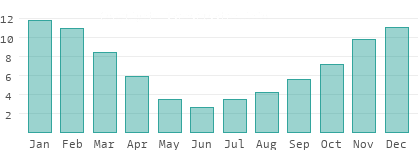
The number of hours of sunshine refers to the time when the sun is actually visible. That is, without any obstruction of visibility by clouds, fog or mountains. With 12 hours per day, January is the sunniest month in the region of Maule. In June, the sun shines the least.
Rain days per month

A rain day is a day on which at least 1 mm of precipitation (=1 liter) per square meter falls. This can be rain, snow, hail, or even dew. So it doesn't have to rain all day. With 8 rain days, June offers the most rain days, while February has the fewest.
The threshold of 0.1 mm, or 1 liter, was set by the World Meteorological Organization (WMO). In the US, the limit is 0.1 inches, or 2.54 mm. In other countries, 0.1 mm (~0.004 inches) is sometimes used. We use the internationally accepted version of the WMO here.
The threshold of 0.1 mm, or 1 liter, was set by the World Meteorological Organization (WMO). In the US, the limit is 0.1 inches, or 2.54 mm. In other countries, 0.1 mm (~0.004 inches) is sometimes used. We use the internationally accepted version of the WMO here.
Precipitation amount in mm/day

The amount of precipitation is measured in millimeters per square meter. Thus, at two mm/day, two liters of water fall on one square meter within 24 hours. With only 0.1 mm, the least amount of rain falls in February. June, on the other hand, has the most rain.
Climate charts for other regions in Chile

Most important cities in the region "Maule"
Alone 3 cities with over 100,000 inhabitants are located here. The region has a west-east extension of about 110 km and over 140 km from north to south.The position of the weather station used for the above climate evaluations is also marked on the map.
| City | Population | Geo position | |
|---|---|---|---|
| Talca | 242,344 | 35° 25' 35"S | 71° 39' 20"W |
| Curicó | 171,589 | 34° 58' 58"S | 71° 14' 22"W |
| Linares | 103,958 | 35° 50' 48"S | 71° 35' 35"W |
| Constitución | 37,917 | 35° 19' 60"S | 72° 24' 42"W |
| Cauquenes | 31,362 | 35° 58' 2"S | 72° 19' 21"W |
| Molina | 28,775 | 35° 6' 51"S | 71° 16' 56"W |
| Parral | 26,904 | 36° 8' 35"S | 71° 49' 34"W |
| San Javier | 22,427 | 35° 35' 43"S | 71° 43' 45"W |
| San Clemente | 13,656 | 35° 32' 16"S | 71° 29' 13"W |
| Rauco | 8,566 | 34° 55' 32"S | 71° 19' 2"W |
| Teno | 6,858 | 34° 52' 14"S | 71° 9' 44"W |
| Longaví | 6,325 | 35° 57' 54"S | 71° 41' 1"W |
| Colbún | 3,679 | 35° 41' 42"S | 71° 24' 20"W |
Population refers to the city proper, not metropolitan areas.
Data basis: German Weather Service, individual values averaged and supplemented by own elements. Data on cities and inhabitants: geonames.org, United Nations Statistics Division and own research.